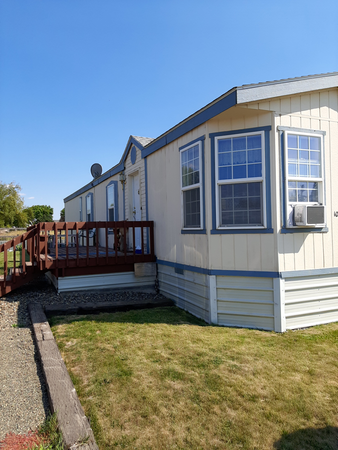
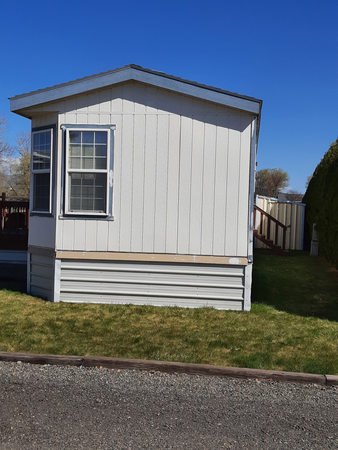
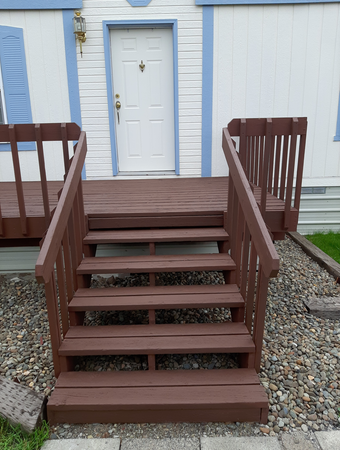
Dan Autry has lived self-sufficiently in his Kittitas home for more than 26 years. He’s a retired Vietnam veteran, and when his manufactured home needed work, he welcomed in Kittitas County Habitat for Humanity volunteers.
Dan takes pride in his home, and it needed a new paint job that didn’t fit his budget. “Those volunteers painted the whole home,” Dan says happily. “In fact, Tahaina (Petrovitch, on the Habitat staff) did 90% of the painting herself.” The Kittitas crew also replaced the sheeting that circles his home from ground to its outside wall and they added insulation to his front and back doors.
Dan learned about Kittitas County Habitat from a friend who told a friend, and he was delighted he could qualify for repairs assistance. He says his home is looking so much better and , “the work Habitat did was great.”
After two tours of duty in the Army during the Vietnam war, most notably during the TET offensive, Dan became a civilian in 1979. “To me it was just about getting out, coming home, taking off that uniform, and being a civilian.” He’s satisfied these days to stay in his home and take care of himself. He’s grateful for the service Habitat extended to him.
“I appreciate everything they’ve done for me. I drop in just to say ‘Hi’ to Tammy and Tahaina. They’re real nice people.” He adds that he spreads the word about Habitat whenever he can so others might get the help they need – just as he did.
Habitat for Humanity Seattle-King & Kittitas Counties joins Habitat International in mourning the passing of Rosalynn Carter. And, while we mourn the loss of her light, we celebrate her decades of inspiration for and dedication to the notion that everyone deserves a safe, decent, and affordable place to call home.
Rosalynn and former President Jimmy Carter found that Habitat for Humanity’s mission aligned with their own values in 1984, when they joined the then fledgling organization. In September of that year, the Carters led a Habitat for Humanity work group to New York, serving 19 families in need of safe, affordable housing. That was the inaugural Carter Work Project. In the decades since then, the Carters have inspired millions, working alongside more than 104,000 volunteers in 14 countries to build, renovate and repair 4,390 homes. The Carters went on to create global awareness of Habitat’s mission, helping the organization expand its work into local communities across all 50 states and in 70 countries.
Rosalynn and Jimmy Carter became Habitat’s best-known volunteers, earning them inaugural membership in Habitat Humanitarians in 2016. Habitat Humanitarians is a group of volunteers who also serve as tireless champions, advocates, and spokespeople to raise awareness of the need for decent, affordable shelter in the U.S. and around the world.
“Over the years, she blessed us with her compassion for serving others and commitment to improving housing conditions around the world,” says Habitat International CEO Jonathan Reckford. “Mrs. Carter helped change the lives of thousands of homeowners, empowered countless women, and inspired millions of people.”
Mrs. Carter’s example infused Puget Sound area Habitat volunteers with enthusiasm for helping others, and we’ve shared in the joy she celebrated that comes from witnessing new Habitat homeowners receive their keys. When asked what kept her engaged in Habitat year after year, Mrs. Carter said, “If you could see the expression on the faces of the people when we give them a Bible and the keys to their house, you would know why. It is just so inspiring. It is really emotional. We always cry. It’s the families that keep us going.”
Habitat for Humanity King & Kittitas Counties CEO Brett D’Antonio is certain our regional chapter will continue to draw inspiration from Mrs. Carter’s dedication, “Rosalynn believed that her work with Habitat made her a better person, and she endorsed volunteering to build homes as a life changing experience.”
The Carters impact on Habitat for Humanity goes on. The next Jimmy and Rosalynn Carter Work Project will take place in Twin Cities, MN in September 2024.
In a significant move to tackle Seattle’s housing crisis, voters are preparing to make a crucial decision on the city’s largest-ever property tax measure for affordable housing.
The latest iteration of the Seattle Housing Levy aims to raise an impressive $970 million over a span of seven years, which is more than triple the existing levy set to expire at the end of this year. Supporters of the levy assert that it represents a “critical investment” in the city’s housing stock, emphasizing the urgency of addressing the housing shortage.
Patience Malaba, a leader of the Yes for Homes campaign and the executive director of the Housing Development Consortium, underscores the gravity of the situation, stating, “We are in a deepening housing crisis that demands more tools at scale, and this levy rises to meet the moment.” However, not everyone is in unanimous agreement, as the levy also has prominent skeptics who advocate for alternative strategies to address the housing challenges facing Seattle.
In response to Seattle’s growing affordability challenge, voters in the city will soon make a crucial decision regarding Proposition No. 1, a new citywide housing levy. If approved, this levy is projected to generate approximately $970 million over the next seven years, primarily allocated to affordable housing projects and rental assistance. The stark reality is that Seattle is grappling with a shortage of approximately 21,000 affordable housing units, forcing many workers, long-term residents, and families to leave. Read the full Axios article here.
Mayor Bruce Harrell and groups like Habitat for Humanity are urging voters to pass the levy, citing the urgency of the city’s housing crisis. According to Ryan Donohue, Chief Advocacy Officer for Habitat for Humanity Seattle-King and Kittitas Counties told Axios, the levy will cost the average Seattle household roughly “the price of a large pumpkin spice latte every week.” As Cliff Cawthon, the group’s Advocacy and Policy Manager, puts it, that’s “a small price to pay to make sure our neighbors have a safe and affordable place to live.”
Proposition No. 1 aims to renew an expiring property tax levy that was last approved by voters in 2016. However, there’s a significant change in the tax rate, which will triple from $0.14 to $0.45 per $1,000 in assessed property value. For the owner of a median-value Seattle home, this translates to an estimated annual cost of $383, about $260 more per year than the expiring levy.
The impact of this levy is substantial. More than $700 million will be channeled into building and preserving approximately 3,500 units of affordable housing over seven years. An additional $30 million will be designated for short-term rental assistance and homelessness prevention, potentially assisting around 4,500 individuals. Furthermore, $50 million will be dedicated to supporting individuals in becoming homeowners through affordable home construction and down payment assistance, while $122 million is earmarked for permanent supportive housing. Overall, the levy could positively impact around 9,000 people, as estimated by city officials.
For Sudhanshu Kumar, his first car meant independence in his new country.
“When I moved to the States, before I learned how to drive or owned this car, I had to rely on others to move around,” he said.
Once he earned his license and his Hyundai Tiburon, Sudhanshu was free to go wherever he wanted.
“I still remember finding the best pancake place in the city and driving this car to get there. That’s one of the moments I felt such immense happiness and freedom.”
Sudhanshu recently donated his Tiburon and all those memories to Habitat for Humanity’s Cars for Homes program.
“I thank this car for such wonderful memories, and while I part with it, I am also happy to know if it might be of some use and value to others in need.”
Indeed, Sudhanshu’s generous donation will provide significant support to Habitat’s mission of providing everyone a decent and affordable place to live. Since 2005, Habitat’s nationwide Cars for Homes program has raised more than $30 million and repurposed over 120,000 cars.
In addition to helping fund affordable homeownership, the Cars for Homes program helps to reduce carbon emissions in our atmosphere. According to a carbon reduction study by Worcester Polytech Institute, cars recycled properly can play a big role in reducing carbon emissions in the automotive manufacturing industry because recycling reduces the need to refine new materials.
Sudhanshu learned about Habitat’s Cars for Homes program from an ad on a Metro bus.
“I was commuting here in Seattle when I saw a sticker for an option to donate the car. I knew then and there if I ever parted ways with my Hyundai Tiburon, that’s what I would do. Being able to do that is such a wonderful feeling.”
Habitat’s Cars for Homes program is a win-win for potential homeowners, for the environment and it’s personally gratifying for the donor. Donating a vehicle – cars, trucks, RVs, vans, SUVs, boats, and motorcycles, running or not – is simple. Towing is free! And many are tax deductible. Click the link for details and instructions.